

OCCULTISM
EXPLANATION
The ancient methods of occultism within Japan traces its origins to the earliest spiritual practices of Shintoism, where unseen forces were believed to manifest within all things. Be it mountains, rivers, objects, and even words, carried spiritual weight within the world. Those attuned to this spiritual energy, learned to interpret, influence, and manipulate it to protect themselves.
As these early traditions evolved, they further merged with ideologies such as Buddhism, and the cosmological practices of Onmyōdō, which formed a structured approach to invocation and warding. Through this synthesis, occultists began to hone their craft, binding intention to symbol, and symbol to effect.
The art of occultism can be split into five portions, that being the creation of resonant tools to be used in ritualistic purposes, each inscription, warding, invoking, and cursing. Each of which must be deliberately taught to an aspiring occultist by one who holds a valid mastered application. Once an occultist knows every method of occultism, they may submit an additional application to gain Occultism Mastery.
RESONANT TOOLS
Among the methods of occultism, is the resonant tools of spiritual manifestation. Any seasoned occultist is capable of constructing their own items for the binding and manipulation of their spiritual intent. Each of these tools must be specifically taught to the occultist, as well as the subservient effects of each inscription. Upon the creation of a resonant tool, the occultist must create a ticket for a spirit team member to sign the object.
➧ OFUDA
An Ofuda is a sacred talisman which is typically issued by a shrine, though occultists can create their own, scribing them with the name of a spirit or blessing, and placed within a fixed location to establish its inscriptions effects. A severe downside to ofuda, is that they must be placed upon every threshold of a room to fully secure the room which includes doorways, windows, ventilation hatches etc.
➧ OMAMORI
An Omamori is a sealed portable charm that contains a sacred blessing or prayer. Protected by a silk bag, within lies a fuda, which is a small prayer that acts as the omamori's catalyst. It may be carried by an individual for personal protection, luck, or whatever inscription is placed onto its surface. Unlike ofuda, it is meant to travel with the bearer which offers permanent, yet weaker spiritual effects. Omamori should never be opened.
➧ STRAW EFFIGY
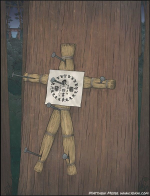
Rarely seen, yet extremely effective, are straw effigies which are woven from dried straw, and affixed with an ofuda nailed into the figure’s face. These effigies utilize the ofuda’s inscription, yet expand the effect to cover a wide area around it. To channel this strengthened effect, effigies require a physical anchor, be it blood, hair, or bone fragments tied to, or woven into the effigy’s core.
Ability Restrictions
- Any resonant tool utilizing an inscription requires for the Occultist to create a Spirit-Team ticket, including the relevant information, as well as a google document which includes their approved Occultist application, and relevant screenshots providing evidence of the creation roleplay.
- To activate an Ofuda, 2 emotes must be properly roleplayed. The first, brandishing the ofuda, with the second applying, and activating it.
- Ofuda must be large enough to be clearly read by the naked eye. While they can be hidden by placing objects infront of them, they cannot, for example, be placed within walls.
- Ofuda must be placed on every entrance to a room, or building, to function.
- If an Omamori is opened, or damaged in any way after creation, it falls inert.
- Omamori must be carried on a person in order to function.
- Effigies require 3 emotes to activate, and have an effective range of 15m once activated. The first, brandishing the effigy, the second activating it, and the third placing, or hammering it into place.
INSCRIPTIONS
While numerous different inscriptions can be utilized, a noted 10 have a significant effect upon Norowarejima. When invoking, warding, or cursing a certain spirit or individual, their true name must be inscribed after the effect, to funnel the inscription’s effect directly toward the intended target.
守護 - Shugo
➧ Ofuda: Establishes a protected zone within a room, bolstering the mental fortitude of its inhabitants.
➧ Omamori: Bolsters the holder’s mental fortitude, allowing them to resist supernatural fear.
➧ Effigy: Creates a localized field in which any being within gains resistance to mental afflictions.
結界 - Kekkai
➧ Ofuda: Forms a barrier that covers the entirety of the threshold, in which spirits cannot pass through.
➧ Omamori: Manifests a temporary barrier to absorb the kinetic force of a single attack..
➧ Effigy: Generates a dome-like barrier that outstretches around a large radius, in which spiritual beings cannot pass through.
祓除 - Harai
➧ Ofuda: Gradually purifies the interior room of lingering spiritual residue.
➧ Omamori: Purifies one corruptive affliction that the holder bears.
➧ Effigy: Emits a pulsing wave of purifying energy that eats away at spiritual residue.
安 - An
➧ Ofuda: Gradually calms all inhabitants that enter the threshold. Includes both spiritual, and mundane beings.
➧ Omamori: Stabilizes the bearer’s emotions, allowing them to resist panic and emotional manipulation.
➧ Effigy: Generates a calming field that somewhat suppresses aggressive intent within its radius.
召喚 - Shōkan
➧ Ofuda: Temporarily manifests a Veil into Yomi upon the threshold, allowing a named spirit to manifest should they be willing.
➧ Omamori: Naturally draws lesser spirits to the bearer over time.
➧ Effigy: Overwhelms the area with malevolent spiritual residue.
憑依 - Hyōi
➧ Ofuda: Should a spirit pass through a threshold with this inscription, it will be forcefully inserted into a living host.
➧ Omamori: Naturally weakens the holder’s mental fortitude over time, making them susceptible to spiritual affliction.
➧ Effigy: Weakens the fabric of reality around the afflicted area, causing Veil manifestations to be more likely.
招来 - Shōrai
➧ Ofuda: Invites a specific, named spirit into the threshold, bolstering their spiritual strength.
➧ Omamori: Makes the holder more visible and appealing to spirits, for better, and for worse.
➧ Effigy: Broadcasts spiritual residue over a wide area, drawing nearby spirits in.
呪詛 - Juso
➧ Ofuda: Places a localized curse upon the threshold, afflicting anyone who passes through it.
➧ Omamori: Inflicts a lingering curse onto the bearer, that which makes them more susceptible to spiritual manipulation.
➧ Effigy: Ties an inscribed curse onto the named individual, weakening their mental fortitude.
束縛 - Sokubaku
➧ Ofuda: When placed on the inside of a door, spirits become trapped within the room.
➧ Omamori: Should a spirit be tied to the bearer, it binds the spirits power significantly.
➧ Effigy: Binds the effigy with the inscripted individual, capable of transferring physical and spiritual damage.
死招 - Shishō
➧ Ofuda: Draws restless spirits in to manifest inside of the threshold.
➧ Omamori: Causes the bearer to be afflicted with nightmares that plague their dreams, often showing them numerous ways in which they may die.
➧ Effigy: Manifests as a convergence point, drawing all lost souls in the area to gather.
ADVANCED METHODS
And yet even with these numerous methods, a skilled occultist may take it a step further. A practiced occultist does not simply rely on the rudimentary forms of inscription, but instead can layer, combine, and harmonize them further into complex methods. Through advanced utilization of omamori, ofuda, and effigies, an occultist may use these tools to amplify one another. At this stage, they must also contend with spiritual saturation, in which the more spiritual influence poured into a space, the thinner the boundary between the living world and Yomi becomes. Through warding, one may erect powerful barriers and banish spirits, manifest them wholly into the living world with invocation, and channel their malevolence to afflict others with curses. While it is not required to learn the basics before utilizing these advanced methods, it is greatly encouraged.
WARDING
The first, and arguably most common methods of occultism upon Norowarejima, is warding. Utilizing these inscriptions, an occultist can repel, disrupt, or contain spiritual beings.
➧ Disruption: The most immediate, and rudimentary form of warding that an occultist may use. Be it drawing a crude barrier with chalk, sprinkling a line of salt upon a doorway, or jingling a kagura suzu to disrupt spiritual presences.
Ability Restrictions
- Requires the method to be taught by a player with a valid Mastered Occultist Application, and for them to know every method of Warding.
- Requires 2 emote with clear effort behind it per method of disruption. The first emote to prepare the disruption method in hand, the second emote utilizing it.
- While typically any freeform method of disruption can be used, the occultist must use historically accurate Shinto or Buddhist methods of repelling spirits.
➧ Warding: A more deliberate laying of protection across an area, an occultist may utilize multiple ofuda, placed across every viable threshold, ensuring that there are zero access points in which a spirit may pass through.
Ability Restrictions
- Requires the method to be taught by a player with a valid Mastered Occultist Application.
- Requires 3+ emotes with clear effort behind them. 2 emotes must be carried out per every threshold warded. The first emote to activate the inscription, the second to place the ofuda. 1 emote must be added to the final count, to deliberately ward the room.
- The occultist must utilize any of the three warding inscriptions, namely Shugo, Kekkai, and Harai.
➧ Banishment: The most absolute, and taxing method of warding. A formal ritual must be carried out by no fewer than three occultists, designed to entirely expel a spirit from the living world, or sever its connection from its chosen anchor. Unlike the simpler methods of warding, banishment requires precision, and concentration.
To entirely banish a spirit, the occultists must first uncover its true name, and inscribe it upon an effigy inscribed with Harai. Next, the effigy must be placed within the center of a room, with a line of chalk surrounding it, no fewer than 2-3 meters in radius. Once the chalk has been drawn, the occultists must begin chanting the spirits name with purifying mantras, whilst sitting on the chalk circle’s exterior. Once the chanting begins, the occultists must continue three times uninterrupted, else the banishment ritual will fail entirely, and backfire. After the third round of chanting mantras, the spirit will be dragged back to Yomi, in which the effigy must be purified, or destroyed with fire.
An alternative to banishment, would be to seal the spirit within an anchor. Instead of an effigy acting as the ritual’s focal point, one could use any object inscribed with a Sokubaku ofuda to seal the spirit inside. Thus, creating a cursed anchor that can be sealed away, or destroyed at a later date.
Ability Restrictions
- The leading occultist must make a spirit-team ticket BEFORE beginning the ritual, as Banishment requires spirit-team oversight.
- Requires the method to be taught by a player with a valid Mastered Occultist Application.
- Requires 7 emotes total with clear effort put behind them. The first two emotes consist of the spirit's name being inscribed. The third emote requires the effigy being placed in a room, with a chalk circle drawn around it. Three emotes after that must be chanting purifying mantras with the spirit's name, with the seventh and final emote banishing or sealing the spirit.
- Requires at minimum of 3 occultists with approved applications, with one of them to have a Mastered Occultist Application.
- The occultist must utilize the invoking inscription, Harai.
INVOKING
Invocation is the deliberate act of calling upon spiritual beings, be it for knowledge, power, or forced manifestation. Unlike warding, invocation has no methods of repelling or control by default. It simply invites, as such, every invocation carries inherent risk. No spirit is forced to compel without reason, and an unprepared occultist is the perfect prey for a newly summoned spirit.
➧ Oneiric Invocation: The most fragile, and unreliable form of invocation. Oneiric rituals may attempt to contact spirits through the thin barriers of the dreamscape, where the line between Yomi and the living world is the thinnest. Utilizing an omamori or ofuda inscribed with Shōrai, the occultist may place it beneath their pillow before sleep. While chanting the spirits name, or inviting phrase, they may allow their mind to act as the ritual’s medium.
Ability Restrictions
- Requires the method to be taught by a player with a valid Mastered Occultist Application.
- Requires 2-3 emotes with clear intent and effort put behind it. The first emote must include the preparation of the ofuda or omamori. After the occultist goes to sleep, they may submit a ticket for a spirit-team interaction or notify nearby spirits of the invocation.
- Any memories gained by the dream must be approved by spirit-team else they will be fragmented and inconclusive.
- A spirit may appear in the dream, but there is 0 guarantee it is the correct spirit, or that it will be honest.
- The occultist must utilize the invoking inscription, Shōrai.
➧ Mirror Invocation: Typically more successful than Oneiric invocation, yet exceedingly volatile. Utilizes a mirror, candle, and an ofuda placed upon the mirror inscribed with either Shōkan, Hyōi, or Shōrai. This ritual must be performed within a small, dark room. The ritual may begin when the occultist places the candle upon their lap, with the mirror before them. Through repeated chanting and focused, intentional eye contact with their own reflection, they may attempt to weaken the boundary between realms.
Ability Restrictions
- Requires the method to be taught by a player with a valid Mastered Occultist Application.
- Requires at least 4 emotes with clear effort. One to prepare the ritual space, and the final three to chant and invite the spirit, while their reflection distorts over time.
- While a spirit may manifest, there is no promise that it is the intended spirit, or that they will be passive.
- The occultist must utilize any of the three invoking inscriptions, namely Shōkan, Hyōi, or Shōrai.
➧ Embedded Invocation: This method is arguably the most powerful, yet most demanding form of invocation. A formal ritual must be carried out by no fewer than three occultists, one being a master occultist.
Rather than calling a spirit widely across the veil, the occultist may use a previously cursed or blessed object as the anchor to hone in, and only contact that sole spirit. The occultist must cover or surround this object in invocative ofuda, inscribed with either Shōkan, Hyōi, or Shōrai. Unlike other methods, embedded invocation creates a stable presence, fully manifesting the spirit into the living real.
To begin, the anchor must be placed within the center of a large room, then it is covered, or surrounded by no fewer than four inscribed ofuda. An optional boundary may be established with both salt or chalk, surrounding the ritual site. After which the occultist must invoke the spirit’s true name, mixed with three counts of invocative chanting as the anchor draws the spirit in.
Ability Restrictions
- The leading occultist must make a spirit-team ticket BEFORE beginning the ritual, as Embedded Invocation requires spirit-team oversight.
- Requires the method to be taught by a player with a valid Mastered Occultist Application.
- Requires at minimum of 3 occultists with approved applications, with one of them to have a Mastered Occultist Application.
- Requires 6-7 emotes total with clear effort put behind them. The first two emotes consist of the ofuda inscription, and applying them to the ritual site. Three emotes after that must be chanting invocative mantras with the spirit's name, with the seventh and final emote fully manifesting the spirit in whole. An additional e mote may be done before chanting, should the occultists wish to establish a boundary with salt or chalk.
- The occultist must utilize any of the three invoking inscriptions, namely Shōkan, Hyōi, or Shōrai.
CURSING
Cursing is the act of afflicting a victim through supernatural means with misfortune, decay, or direct harm by contacting malevolent spiritual beings. Unlike invocation or warding, cursing does not require a direct manifestation of the aggressing spirit, but instead channels its malevolence into a sustained effect. All curses carry heavy consequences, the more potent the curse, the greater risk that it may backfire upon the occultist.
➧ Kotodama Curse: The weakest and often most unreliable form of cursing, relies solely on spoken word and intent. Rooted in the ancient belief that speech holds spiritual power, the occultist may channel their malice through spoken phrases, names and declaration of hatred unto their victim. Without a physical anchor or ritualistic reinforcement, kotodama curses are often fleeting and wildly inconsistent. Their effects are often noticeably subtle, causing minor misfortunes, unease, or emotional fluctuation.
Ability Restrictions
- Requires the method to be taught by a player with a valid Mastered Occultist Application.
- Requires 4 emotes with clear effort. One emote to establish intent and focus on the target, two to channel that malice forward and call upon spiritual beings, and the final to attempt to deliver the curse.
- Effects are often minute and weak, with spirit-team discretion inflicting these misfortunes upon the victim.
➧ Tsukumogami Curse: An erratic and slow-forming curse that transforms an object into an anchor of accumulated malice. The anchor must be imbued daily with hatred or negative emotions, and then gifted to the victim. Through repeated exposure to negative emotion, be it hatred, grief, resentment or otherwise, the anchor may begin to awaken as a tsukumogami. The object in question must in some way hide an ofuda or omamori inscribed with either Juso, or Shishō within it.
This process is wildly unstable. The object may fail to awaken, turn on the occultist, or act unpredictably. Maintaining possession of the object long enough to complete the curse is often the greatest challenge.
Ability Restrictions
- Requires the method to be taught by a player with a valid Mastered Occultist Application.
- While there is no required emote count, every emote of detailed interaction with the to-be tsukumogami powers it further. The more hatred, the stronger it is. Occultists are expected to screenshot every instance of an attempt to power it, and create a spirit-team ticket to transform it into a tsukumogami.
- Upon creation, a d20 will be rolled to decide success rate, scaled with each moment of imbuement.
- The occultist must utilize any of the two cursing inscriptions, namely Juso or Shishō.
➧ Straw Effigy Curse: The most powerful, and ritualistic method of cursing. This form binds a target to a physical representation, allowing sustained and escalating harm through repeated ritualistic action.
The occultist must create seven identical straw effigies, each with an inscribed cursing ofuda nailed into the head, each with a fragment of the victim within it. Over the course of seven consecutive nights, between the hours of 1-3 AM, these effigies must be nailed into any sacred tree, while invoking the victim’s name.
The ritual gets stronger with each successful night, whereas missing a night, being interrupted, or performing the ritual incorrectly will cause the curse to fail entirely, and create severe backlash upon the occultist. The effects manifest upon the third night, as escalating misfortune, spiritual oppression, or physical harm tied directly to the ritual’s success.
Ability Restrictions
- The occultist must make a spirit-team BEFORE travelling to a shrine nightly, as the Straw Effigy Curse requires spirit-team oversight.
- Requires the method to be taught by a player with a valid Mastered Occultist Application.
- Requires a minimum of 14 emotes total, spread across 7 IRL nights. 2 emote per night. Additional detail is strongly encouraged.
- Requires the cursing occultist to travel to any tree within at least 40 meters of a shrine, or any tree upon clearly defined shrine grounds.
- The ritual must be uninterrupted across all nights. Failure at any stage, or the removal of the nailed effigies result in total collapse of the curse, and potential backlash determined by staff or roleplay agreement.
- Should the occultist have a valid combat motive against the victim, the effects may transfer to physical, irrevocable damage.
- The occultist must utilize any of the two cursing inscriptions, namely Juso or Shishō, in which the effigy will be permanently consumed for each successful use.
PURPOSE
Hi YJ so basically instead of people falling victim to spirits, with absolutely zero way to defend themselves mechanically, we now have Occultism. A roleplay route discoverable ONLY IN ROLEPLAY, players can season themselves with occultist arts to exorcise and manipulate spirits if theyd like :3